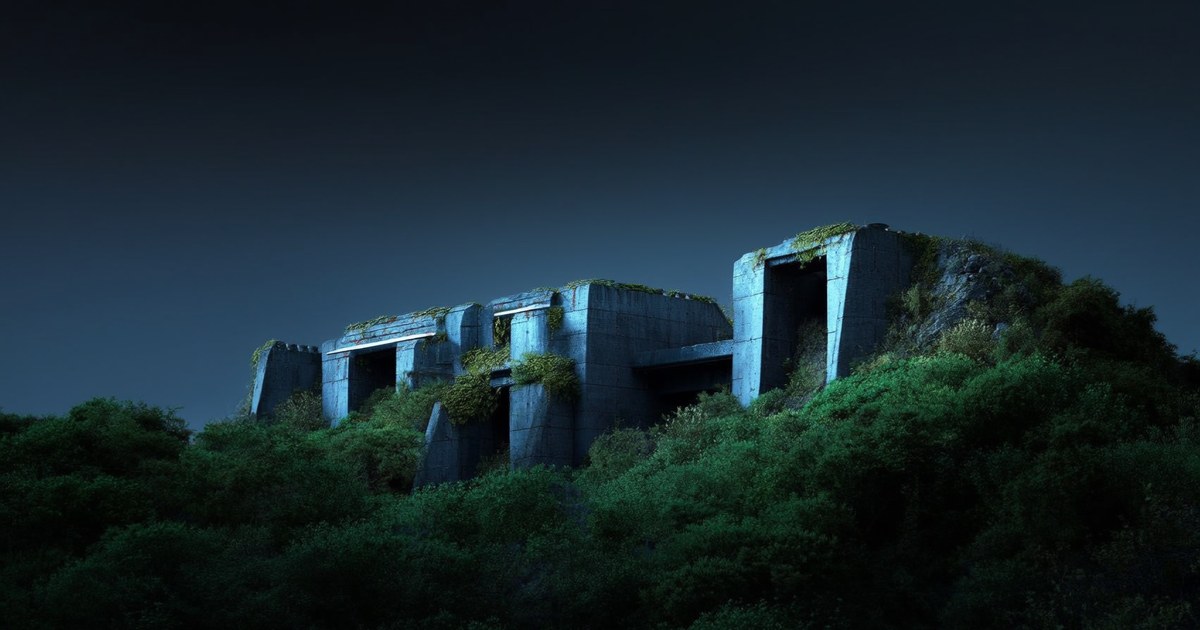
Civil War remains discovered during forest cleanup in Oviedo
A municipal work crew in Oviedo received an unexpected surprise in July while carrying out forest cleaning work in El Campón, an area within the municipal boundaries. As a brush cutter passed over what appeared to be an ordinary path, the machine struck reinforced concrete and a 1937 gun emplacement, a Republican defensive structure that had remained hidden under ferns for nearly nine decades. What began as a routine fire prevention operation ended with a discovery that reveals how much Spanish Civil War heritage remains buried across Spanish territory.
A front beneath the scrub of Mount Naranco
Mount Naranco, on the outskirts of Oviedo, was the scene of intense combat during the conflict. Following the Republican siege of the city in 1936, which was broken in October, Republican defenders fortified the heights to control the passes towards Grado. Mount Naranco was filled with trenches and firing positions that were maintained until the end of the war.
Records indicate that dozens of defensive structures were built in this area. In El Rebollal, thirteen combat positions have been counted; in Campo Cimero, the figure rises to thirty-one, distributed across four arcs towards the northwest, forming Asturias's largest defensive complex. A notable example is the Ayones nest, which preserves its original geometry: seven sides on the exterior, cylindrical on the interior, built in 1937 by the Republicans.
Tens of thousands of structures lost in the undergrowth
The discovery in Oviedo is not an isolated case. According to xataka.com, the BunkerAtlas database has catalogued and geolocated 192 defensive positions across Spain, although this figure represents barely a sample of actual heritage.
Available data shows dispersed but significant distribution:
- Madrid concentrates nearly 19% of what has been catalogued, with more than 2,000 documented fortifications across one hundred municipalities; the capital alone contains 531 inventory records
- Catalonia accounts for around 16% of the total
- Navarre for 12%
- Aragón for 11%
Almost six out of every ten recorded structures were built during the Civil War by both sides. If one adds Franco's ambitions in the Pyrenees—where he designed the P Line with ten thousand bunkers planned across 500 kilometres of border, of which fewer than 4,000 were completed—the real number of defensive structures certainly reaches tens of thousands. Most remain beneath undergrowth, awaiting inventory and decisions about their future.
The race against time and resources
Spain has a legal framework to protect this heritage. The 2007 Historical Memory Act, expanded by the 2022 Democratic Memory Act (revised in March 2026), requires these remains to be identified and protected, and even opened to the public in some cases. However, the main obstacle is budgetary.
Cataloguing thousands of kilometres of trenches, small forts and bunkers requires investment that does not always materialise. Each recovered structure depends on local initiatives: an interested municipality, a historical memory association, or in cases like Oviedo's, a forestry crew that accidentally stumbles upon the past. Managing the present continues to consume resources that should be devoted to documenting the past.
What happens now with the El Campón discovery?
For now, it has not been disclosed whether Oviedo's municipal authorities have initiated any specific documentation or protection protocol for the find. What is certain is that it will find its place in military heritage databases, and its fate will depend on administrative decisions that balance limited budgets with local priorities.
The discovery raises an uncomfortable question: how many machine gun nests, trenches and shelters continue to sleep beneath Spanish mountains, waiting for a brush cutter, an excavator or the passage of time to expose them once again?
Source: xataka.com