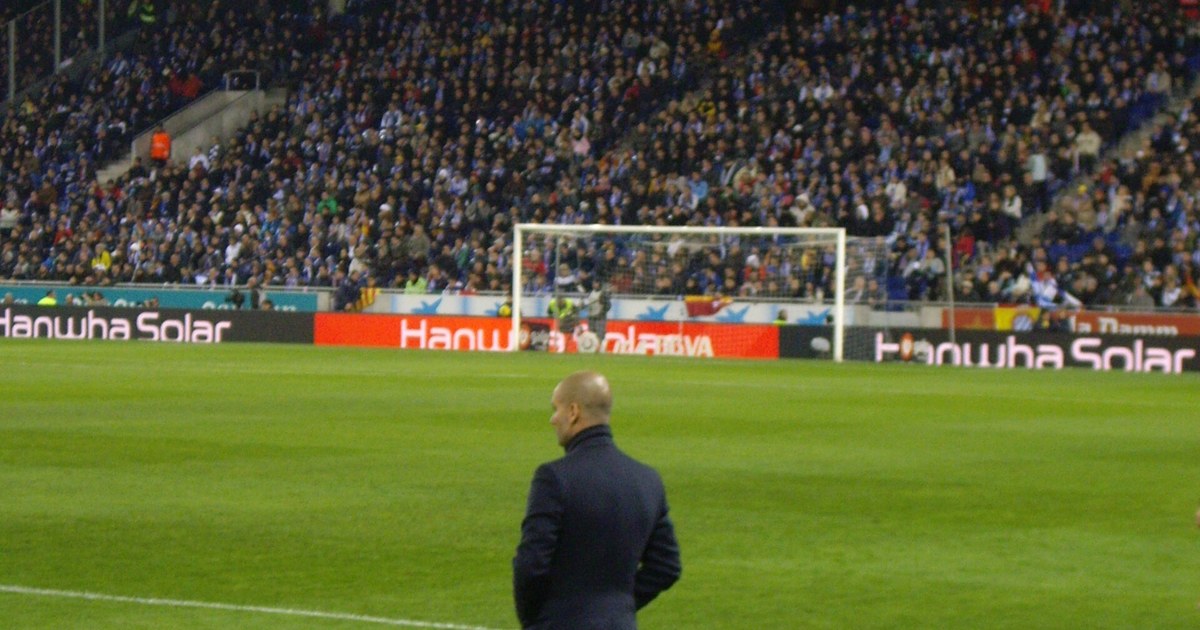
Photo: Arnaucc, CC BY-SA 3.0, Wikimedia Commons
Pedro León: Playing against Guardiola's Barcelona meant 90 minutes chasing the ball
Fourteen years after Pep Guardiola left the FC Barcelona bench, his legacy continues to spark conversation among those who faced him on the pitch. Now it is Pedro León, former Real Madrid player and current president of Real Murcia CF, who has revealed the nightmare that playing against that blue-and-garnet machine represented, in an appearance on the podcast El After de Post United, as reported by sport.es.
Ninety minutes of agony: a former player's confession
León did not mince words in describing his experience facing Guardiola's Barcelona. "It was unbearable," he stated bluntly, with the force of someone who lived through the tactical torment firsthand. The crux of his analysis came when he explained why: "You were practically the 90 minutes of the match chasing the ball".
It was not an exaggeration of the kind common in dressing rooms. León delved into the details of why that Barcelona proved so suffocating for their rivals. The problem was not simply possession of the ball, but the very architecture of the game itself. When Barcelona regained possession, opponents found themselves in a perpetual chase; when Barcelona lost it, they exerted such sophisticated pressure that it left little room to breathe.
The perfect trap: a system with no escape
What was most frustrating for opposing teams was the apparent absence of solutions. León described how even resorting to man-to-man marking, Barcelona found escape routes through coordinated movements and, especially, the use of the goalkeeper as an additional outfield player. "You always found the free man. Even if you went to man-to-man marking, they played with the goalkeeper and waited for the free man to appear so that, with any movement, they would attack you with superiority," he detailed.
This was the hallmark of Guardiola's revolutionary project in Barcelona: a positional play system where possession control and ball circulation predominated, complemented by that high press which allowed no respite. The objective was clear: to make rivals constantly chase the ball, exhausting themselves while Barcelona dictated the pace of the match.
The legacy of four years of glory
Guardiola was in charge of Barcelona between 2008 and 2012, amassing 14 titles in just four seasons: three league titles, two Champions League trophies, two Copa del Rey titles, three Spanish Super Cups and two Club World Cups. A record that, even today, remains difficult to comprehend.
One of the most notable innovations was the false 9 system. By dispensing with a pure centre-forward, the player occupying that position would drag opposing defenders out of their comfort zone, generating spaces that the wingers exploited with surgical precision. With Messi occupying that role, the system reached near-impossible levels of perfection to counter.
The exhaustion of being at the top
Guardiola explained at the time the reason for his departure: "Four years is an eternity to be Barcelona's manager. Time wears everything down". A reflection that illustrated the emotional toll of maintaining excellence at such a prominent club.
Pedro León's conclusion reflected the despair of the vanquished: when they finally regained the ball against that Barcelona, "you couldn't do much more because you were completely shattered from chasing them around so much". A testament that summarises why that was a generation of footballers who not only won, but psychologically subdued their opponents.
Source: sport.es