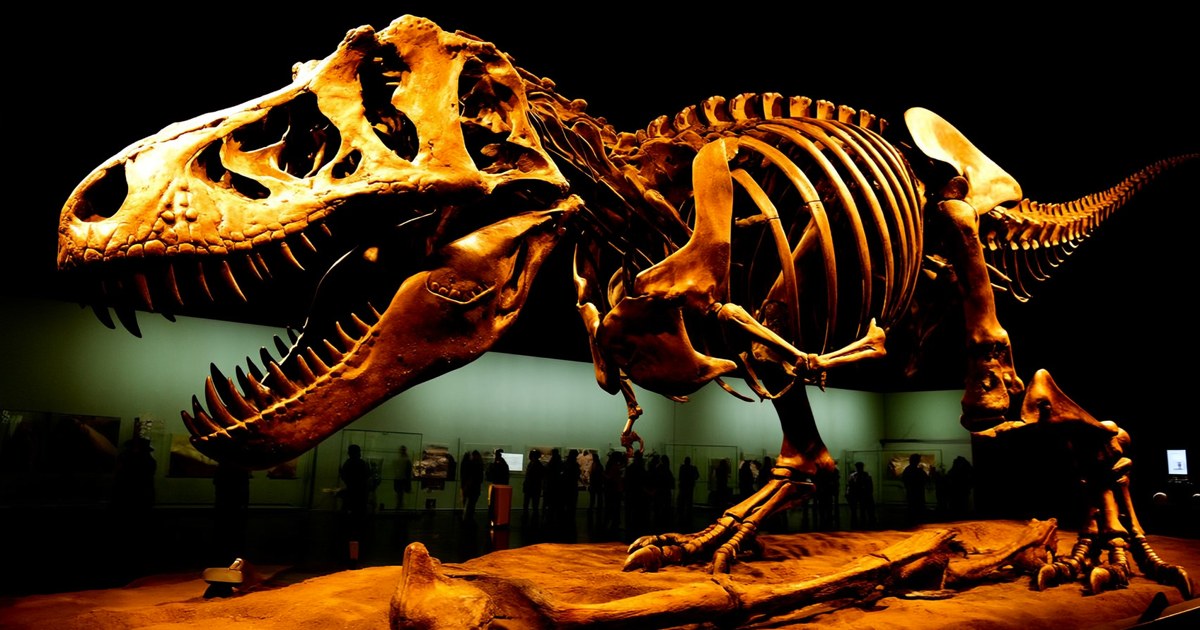
Tyrannosaurus Rex breaks record: sold for 50 million dollars
A nearly complete Tyrannosaurus Rex skeleton has just broken all known records in the fossil market. Its name is 'Gus', and its sale at Sotheby's auction house for 50.1 million dollars marks an unprecedented milestone in commercial paleontology.
The discovery that changed everything
According to abc.es, 'Gus' was discovered on a South Dakota ranch thanks to the meticulous work of Thomas Heitkamp and his team. The land belonged to Gary 'Gus' Licking, a rancher who, aware of the complexity of archaeological work, decided to collaborate with these professionals. Sadly, Licking died just one year after excavation began, without witnessing the discovery that would later bear his name.
The extraction process was extraordinarily demanding: three exhausting summers of excavation followed by three more years of laboratory work. During this time, specialists precisely extracted 183 fossil bone elements, representing approximately 61% of the complete skeleton, an unusually high percentage for a specimen of this type.
The dimensions of a giant
'Gus' is notable not only for its bone integrity but also for its impressive proportions. At 11.6 metres long and 3.8 metres tall, it ranks among the largest T-Rex specimens ever found. These measurements make the fossil a unique piece from both a scientific and commercial perspective.
A tense and historic auction
The bidding at Sotheby's was intense. For ten minutes, seven bidders competed to acquire 'Gus', progressively raising the price to the final figure of 50.1 million dollars. This amount far surpasses the previous record, set by another T-Rex named 'Apex', which was also sold at Sotheby's just a few months ago for 44.6 million dollars. 'Apex' is currently on loan to the American Museum of Natural History in New York.
Cassandra Hatton, vice president of Sotheby's and worldwide director of the Science and Natural History department, expressed her enthusiasm about the result: "The market responds positively when valuable specimens receive proper care". Her comment underscores that excellence in excavation, documentation, preparation and conservation of the fossil was key to achieving such an exceptional value.
What does this mean for paleontology?
The sale of 'Gus' reflects a growing trend: fossils of exceptional quality are increasingly sought after by private collectors, museums and investment funds. However, this generates ongoing debate within the scientific community about whether these discoveries should remain in public hands to ensure access for research.
So far, the identity of the buyer and where 'Gus' will be housed in the future have not been revealed. What is certain is that this skeleton, the fruit of six years of rigorous work, has left an indelible mark on the history of paleontological auctions.
Source: abc.es